
Baby Botox in Scottsdale: What Microdosing Is, Who It Is For, and What It Costs
The most common request our injectors hear right now is not “get rid of my wrinkles.” It is “I want to look rested, not treated.”
That shift has a name. Baby Botox, also called microdosing, uses smaller amounts of neuromodulator placed more precisely, so expression lines soften without the muscle going completely still. You still raise your eyebrows. You still crinkle when you laugh. You just look less worn out doing it.
Here is what the treatment involves, who gets the best results, and what it costs at our Scottsdale practice.
What Is Baby Botox?
Baby Botox is not a different product. It is the same neuromodulator used in a standard treatment, dosed and placed differently. Rather than fully relaxing a muscle, your injector uses a lower dose spread across more injection points to partially soften it.
The goal is subtraction, not elimination. Lines at rest fade. Lines in motion soften but do not disappear, which is exactly the point for patients who want their face to still read as their face.
How Baby Botox Differs From a Standard Treatment
A traditional Botox treatment aims for maximum smoothing in a target area. Baby Botox aims for partial smoothing with preserved movement. The practical differences:
- Lower total units in the treated area
- More injection points at shallower depth, so the effect is distributed rather than concentrated
- More visible movement retained, especially in the forehead and around the eyes
- A shorter runway, because less product means movement returns sooner
Is Baby Botox the Same as Microdosing?
In everyday use, yes. “Baby Botox” is the consumer term, and “microdosing” is the clinical one. Some injectors use microdosing to describe a broader technique that includes very superficial, widely distributed injections intended to improve skin texture and pore appearance in addition to softening lines. If that distinction matters for your goals, bring it up at your consultation, because the two approaches use different placements.
Why “Natural-Looking” Became the Most Requested Result
A decade ago, the measure of a good tox result was how smooth the forehead looked in a mirror. Today, it is whether anyone can tell you had anything done at all.
Part of that is cultural. Patients are starting younger and treating maintenance as routine rather than as a dramatic intervention, which is the same thinking behind preventative aesthetics. Part of it is practical. People spend a great deal of their lives on video calls and front-facing cameras, where a frozen upper face is far more obvious than it is in person.
Lower doses answer both. You get the softening without the tell.
Who Is a Good Candidate for Baby Botox?
Patients Starting Preventatively in Their Twenties and Thirties
If your lines are still dynamic, meaning they appear when you make an expression and vanish when you relax, you often do not need a full dose to get a meaningful result. Starting light and adjusting upward over time is a reasonable approach, and it is easier to add a few units at a follow-up than to wait out a result that went too far.
Patients Who Have Had Tox Before and Felt Too Frozen
This is the single most common reason patients ask us about microdosing. If a previous treatment left you feeling heavy in the brow or unable to show expression, a lower dose in the same areas frequently solves it. Bring specifics to your consultation: which areas bothered you, how long the heaviness lasted, and roughly how many units you received if you know.
Expressive Faces, Performers, and Anyone On Camera
Actors, presenters, attorneys, teachers, and anyone whose work depends on reading as expressive tend to do well with microdosing, because the treatment is built around keeping movement rather than removing it.
Who Is Not a Good Candidate
Baby Botox has limits, and it is worth being direct about them. If you have deep static lines, meaning creases that are visible when your face is completely at rest, a lower dose is unlikely to give you the result you want. Those lines often respond better to a full-dose treatment, to resurfacing, or to a combination approach. If volume loss is the real issue rather than muscle movement, a neuromodulator is the wrong tool entirely, and our Botox or filler breakdown is a good place to start.
A consultation sorts this out quickly. An honest injector will tell you when microdosing is not going to get you where you want to go.
Where Microdosing Works Best
Forehead and the “11s”
The forehead is where over-treatment is most visible and where lower dosing pays off most. Microdosing here softens horizontal lines while keeping enough lift that the brow does not feel heavy. Many patients pair a light forehead dose with slightly more in the glabella, the “11s” between the brows, since that area tolerates fuller treatment without the same frozen appearance.
Crow’s Feet
Smiling should still look like smiling. Lower doses around the eyes soften the lines without flattening the way your eyes move, which is often what patients notice first when a treatment has been overdone.
Brow Positioning
Precise, low-dose placement can create a subtle lift at the tail of the brow. If lifting is your main goal rather than line softening, our non-surgical brow lift approach is worth discussing at your visit.
The Lip Flip
A lip flip is microdosing by definition. A very small amount of neuromodulator along the upper lip relaxes the muscle so the lip rolls slightly outward, giving the appearance of more show without adding volume. It is a popular first step for patients who are curious about lip filler but not ready to commit to it.
Beyond the Face: Masseter and Trap Tox
Neuromodulators are not only for lines. Masseter treatment addresses jaw clenching and can slim a square jawline over time. Trapezius treatment, commonly called trap tox, targets tension in the shoulders and neck and can improve the line of the neck and shoulders.
Every injector at Skin Savvy performs both. Worth knowing before you ask: these sit at the opposite end of the dosing spectrum from baby Botox. The masseter and trapezius are large, strong muscles, so they require substantially higher unit counts than any facial line treatment, and they are priced accordingly. They are functional treatments rather than wrinkle treatments, so bring them up as a separate conversation at your visit.
How Long Does Baby Botox Last?
Less product means a shorter runway. Where a standard treatment commonly holds for three to four months, a microdosed treatment often begins to fade sooner, and you may notice movement returning earlier than you would after a full dose.
That is not a reason to book earlier. We hold re-treatment to a three to four month interval regardless of how light the dose was. Treating more frequently than that can encourage your body to build resistance to neuromodulators over time, which is a problem that compounds and is difficult to reverse. A clinic willing to re-treat you every six weeks is not doing you a favor.
Metabolism, muscle strength, dose, and how much you exercise all affect duration, which we cover in more detail in how long Botox lasts. The tradeoff is straightforward: you are exchanging some longevity for a more natural result. Most microdosing patients consider that a fair trade.
What Does Baby Botox Cost in Scottsdale?
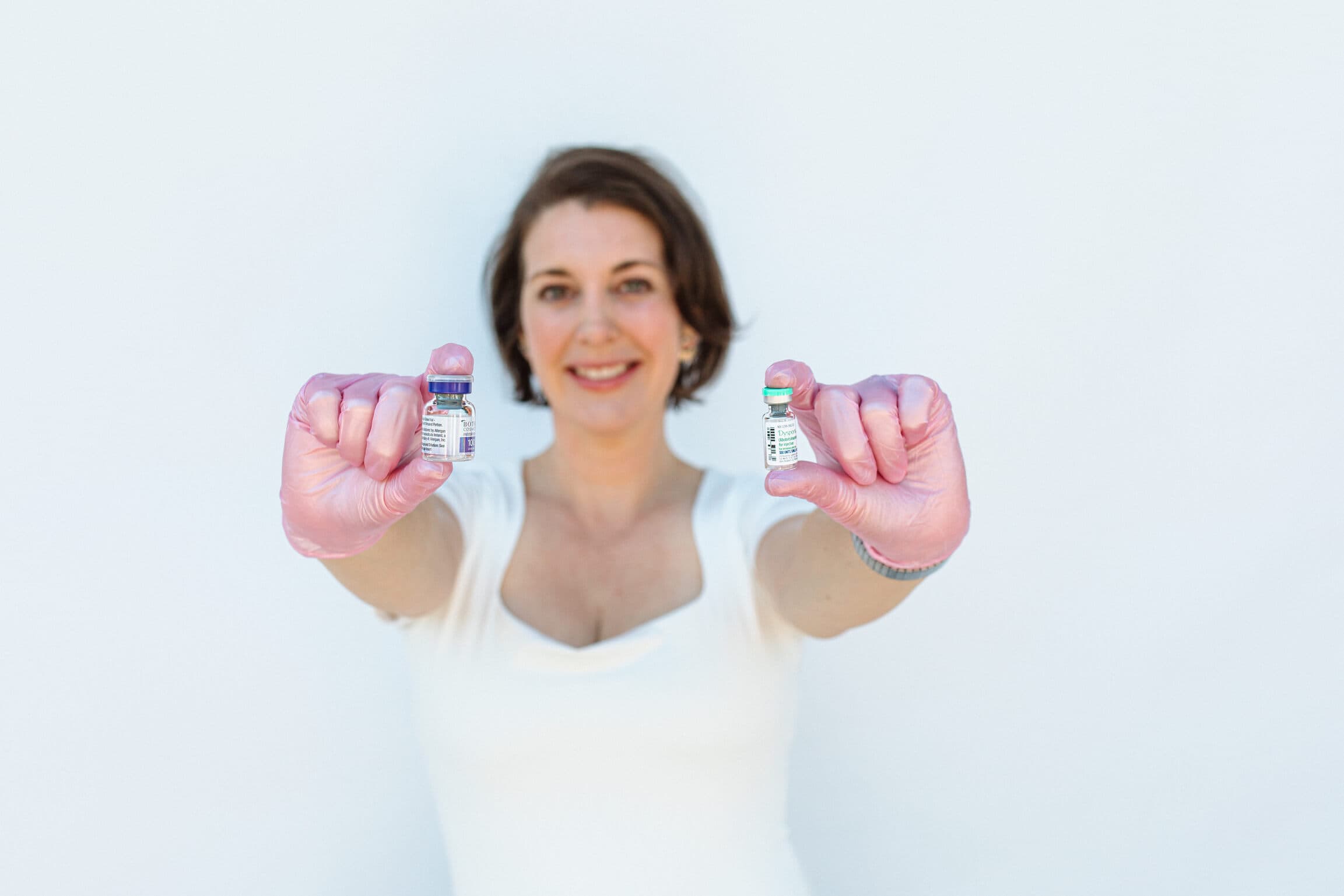
Neuromodulators are priced per unit. At Skin Savvy, that is $12 per unit, or $11 per unit for members.
A microdosed forehead and glabella typically runs 25 to 30 units. The standard FDA-approved dosing for those two areas combined is 40 units. So in practical terms:
- Microdosed forehead and glabella: roughly $300 to $360, or $275 to $330 as a member
- Standard full dose, same two areas: roughly $480, or $440 as a member
That is a meaningful difference per visit. Keep in mind that a lighter dose fades sooner, so your annual spend may land closer to a standard schedule than the per-visit price suggests.
Two things bring the total down further. Our membership program applies the member rate and discounts other injectable services. Manufacturer loyalty programs, including Allē and ASPIRE Galderma Rewards, add points and savings on top depending on which product is used.
Microdosing With Dysport and Daxxify
Microdosing is a technique, not a product, so it can be done with any of the neuromodulators we carry. The product choice changes onset and duration more than it changes the look.
- Dysport tends to take effect quickly and spreads slightly more, which some injectors prefer for broad, soft coverage across the forehead.
- Daxxify is formulated for a longer duration, which can offset the shorter runway of a lower dose. See our Botox versus Daxxify comparison for the full picture.
Your injector will recommend a product based on your goals, your history with tox, and how your muscles have responded before.
Is Baby Botox Safe?
The safety profile is the same as any neuromodulator treatment, and a lower dose does not introduce new risks. What matters far more than the dose is who is holding the syringe. Precise, distributed, low-dose placement is harder to execute well than a standard treatment, because there is less margin for error in mapping the muscle.
Our fuller discussion of Botox safety covers the common concerns. If this is your first injectable appointment anywhere, how to prepare for your first med spa visit walks through what the appointment looks like start to finish.
What to Expect at Your Appointment
Before. Review our pre-care instructions. Briefly, avoid blood thinners and alcohol where medically appropriate for you, and come with clean skin.
During. Your injector maps your muscle movement while you make expressions, then places a series of small injections. Expect roughly ten to fifteen minutes of injection time. Most patients describe it as a quick pinch.
After. Follow our post-care guidance: stay upright for several hours, skip strenuous exercise for the rest of the day, and do not rub the treated areas. Results build over several days rather than appearing immediately.
The two-week assessment matters more with microdosing than with a standard treatment. Because the entire approach is to start conservative, a check at the two-week mark lets your injector see your settled result and make a small adjustment if one area needs a little more. This is a refinement of your current treatment, not an early re-treatment, and it does not shorten the three to four month interval before your next full session.
Baby Botox for Men
Male patients are the fastest-growing group asking for microdosing, and for a specific reason. Men often want the tired look gone without any visible change to how their face moves, and heavier dosing reads as obvious far more quickly on a male brow. Lower, precisely placed dosing suits that goal well. Our guide to Botox for men answers the questions we hear most.
Book a Baby Botox Consultation in Scottsdale
Every face moves differently, which is why microdosing is a conversation before it is a treatment. At your complimentary consultation, one of our injectors will map your movement, talk through what a lower dose can and cannot deliver for your specific lines, and build a plan you can adjust over time.
Skin Savvy Aesthetics has served Scottsdale for more than a decade from our location at 8418 E Shea Blvd, Suite 101. Book your consultation online, call 480-520-0216, or contact us with questions. You can also meet our team before you come in.
Frequently Asked Questions
Will baby Botox still get rid of my forehead lines?
It will soften them. Lines you see at rest should fade noticeably. Lines that appear when you raise your brows will soften but remain visible, which is the intended outcome. If you want those gone entirely, a standard dose is the better choice.
How much does baby Botox cost?
At Skin Savvy, neuromodulators are $12 per unit, or $11 per unit for members. A microdosed forehead and glabella typically takes 25 to 30 units, which works out to roughly $300 to $360, or $275 to $330 for members.
Can I switch from regular Botox to baby Botox?
Yes. Tell your injector what you did not like about your previous results, and they will adjust the dose and placement accordingly.
How old should I be to start?
There is no set age. The better question is whether your lines are dynamic or static. Dynamic lines respond well to preventative microdosing, and that is a more useful signal than a number.
Can baby Botox be combined with other treatments?
Yes, and it frequently is. Microdosing addresses muscle movement, while filler addresses volume and treatments like microneedling address skin texture. Combining them is common, and your injector will sequence them appropriately.
What happens if I stop?
Your muscles gradually return to their previous activity, and your lines return to where they were. Nothing gets worse than it was before you started.